Japanese License Plates
Understanding Kei vehicle plate design, classification, and markings.
Shape and Design
The Japanese government issues license plates for all vehicles. Kei vehicles use a medium-sized plate called Chuban with dimensions of 33 × 16.5 cm (13 × 6.5 inches). Standard (non-Kei) vehicles use a larger plate of the same name but with slightly different proportions — 33 × 16.5 cm for passenger cars and 44 × 22 cm for large trucks and buses.
Plates are made from aluminum with embossed (raised) characters and a retroreflective coating on both the front and rear surfaces for nighttime visibility.
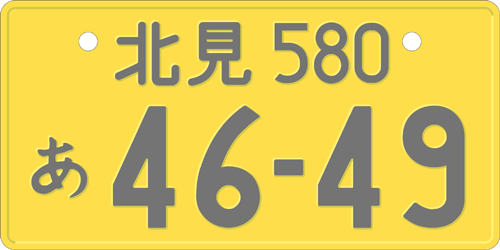
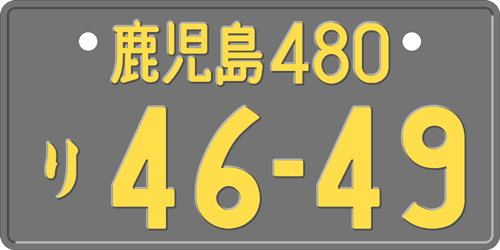
The top line contains the name of the issuing office and a vehicle class code. The bottom line contains a hiragana character and a four-digit serial number divided into two groups of two digits separated by a hyphen. Leading zeros are replaced by centered dots.
License Plate Classification
Japan classifies vehicles by size, engine displacement, and type. The classification code appears on the upper portion of the plate and determines tax rates and certain road restrictions. The full system covers the following ranges:
| Class Code | Vehicle Type | Plate Color |
|---|---|---|
| 1XX | Standard trucks and special-purpose vehicles over 660cc | White background, green text (private) / Green background, white text (commercial) |
| 2XX | Standard buses and large passenger vehicles over 660cc | White / green (private or commercial as above) |
| 3XX | Standard passenger cars — engine over 660cc | White background, green text |
| 4XX | Kei trucks and special-purpose Kei vehicles — 660cc or under | Yellow background, black text (private) / Black background, yellow text (commercial) |
| 5XX | Kei passenger cars — 660cc or under | Yellow background, black text (private) / Black background, yellow text (commercial) |
| 6XX | Three-wheeled vehicles | White or yellow depending on engine displacement |
| 7XX–9XX | Additional commercial and special-use categories | Varies by subtype |
Kei trucks imported to North America — such as the Daihatsu Hijet S110P and Honda Acty HA3/HA4 — will have carried 4XX class codes on their Japanese plates. Kei vans and passenger-configured Kei vehicles typically carry 5XX codes.
Plates on Exported Vehicles
When a Japanese vehicle is deregistered for export, both front and rear plates must be surrendered to the issuing authority as part of the deregistration process. Failure to return plates delays issuance of the export certificate. As a result, vehicles imported to North America do not retain their original Japanese plates — the vehicle arrives without plates and is registered fresh in the destination country.
Local Place Name (Gotōchi)
A place name of 1–4 characters is displayed on the upper left side of the plate. Known as Gotōchi (ご当地, “local place”), as of 2020 there are 133 place names registered across Japan. The place name corresponds to the issuing transport bureau or branch office — vehicles registered in Tokyo display 品川 (Shinagawa), 練馬 (Nerima), or similar district names depending on the specific office.
Gotōchi Regional Design Plates
Separate from the standard place name system, Japan offers optional gotōchi specialty plates featuring decorative regional designs — local tourist attractions, cultural symbols, or prefectural imagery. These were introduced in 2006 and expanded significantly in subsequent years:
- As of recent years, 73 regional designs are available for local residents
- Vehicle owners pay an optional ¥1,000 contribution to regional transportation or tourism funds to obtain a gotōchi plate
- Between April 2022 and April 2027, 41 regional designs featuring prefectural flowers were issued nationwide
- From 2025, monochrome (single-color) gotōchi plates are being phased out in favor of full-color designs only
Kei trucks that were registered in rural prefectures before export sometimes carry gotōchi plate details in their registration paperwork, which can be a useful clue for tracing a vehicle's regional origin in Japan.
Hiragana Use Character
A single hiragana character to the left of the serial number indicates private or commercial use. For Kei vehicles, the permitted characters are:
あ・い・う・え・か・き・く・け・こ・さ・す・せ・そ・た・ち・つ・て・と・な・に・ぬ・ね・の・は・ひ・ふ・ほ・ま・み・む・め・も・や・ゆ・よ・ら・る・を
り・れ
わ
A・B
Excluded Characters
Several hiragana characters are deliberately omitted from the system. The exclusions are a mix of practical and cultural reasons:
| Character | Reading | Reason Excluded |
|---|---|---|
| お | o | Too visually similar to あ (a) — risk of misreading at speed or from a distance |
| し | shi | Sounds identical to 死 — the Japanese word for “death” — considered inauspicious |
| へ | he | Sounds identical to 屁 (“flatulence”) — deemed inappropriate for public plate announcements |
| ん | n | The only hiragana without a following vowel — awkward to pronounce in isolation, problematic for verbal plate reporting |
Serial Numbers
1–4 digit numerals appear to the right of the hiragana character. Numbers are right-aligned; blank leading digits are filled with centered dots (・). When 4 digits, a hyphen separates the second and third digits (e.g., 12-34). By paying a fee, owners can request a specific serial number — this is a common practice for lucky numbers or memorable sequences.
As serial number combinations using only numerals became exhausted in high-demand regions, Japan's Ministry of Land, Infrastructure, Transport and Tourism (MLIT) introduced Latin alphabet letters into the third numeric position. The permitted letters are: A, C, F, H, K, L, M, P, X, Y — chosen to avoid confusion with numerals and other characters. Plates with Latin letters in the number field are a sign of a newer registration and are more common in high-population areas such as Tokyo and Osaka.
Brief Reform History
| Year | Change |
|---|---|
| 1961–1962 | Modern plate system established — classification code, prefecture, hiragana, and serial number format introduced |
| 1967 | Double-digit classification codes introduced as single-digit codes were exhausted |
| 1998 | Current format adopted — regional name moved to upper left, three-digit classification code standardized |
| 2006 | Gotōchi specialty regional design plates introduced |
| 2022–2027 | 41 prefectural flower designs issued nationally as part of a gotōchi expansion program |
| Recent | Latin alphabet letters (A, C, F, H, K, L, M, P, X, Y) added to serial number field to address number exhaustion in high-demand regions |